More value on the shopfloor. Without touching the systems that run production.
Workerbase can connect to the systems you already run and learn what you produce and how you produce it. Your people describe what the line needs. The application is built, released and runs at the workplace.
It starts on the line
You see the problem. You know how to fix it.
Then you raise a ticket and wait four months.
By the time the change arrives, the product has moved on, the line has moved on and the person who asked has moved on with it.
Most improvements on a shopfloor die in that gap.
Workerbase closes it.
1. Workerbase can connect to your systems, so the platform understands your production
Workerbase reads from what you already run. ERP, MES, quality, maintenance, machine data.
From that it knows which products you build, how you build them, which orders are running, which machines are involved and which parts belong where.
That understanding is what turns an application into something useful. It knows the order, the variant, the tolerance and the station, so the person at the workplace does not have to type any of it.
Machine control and planning stay where they are. We read from them.
2. You decide what gets built
Ideas from the line and findings from the floor land in one place. You choose what is worth doing, and you can see what happened to everything else.
A shopfloor does not need five hundred applications. It needs the dozen that change a number, running properly.
3. You describe it. The platform builds it.
You describe the work step in your own words.
What comes out is an application that holds the sequence, guides the person doing the work and captures the data where the work happens. It writes back into the systems you already run, so the result lands where the rest of the business looks for it.
Days, not quarters. No developer, and no waiting for one.
4. It is released, and then it runs
Before anything reaches the floor, a named person releases it. Roles define who is allowed to build what. Every release is logged.
What has to be standard across the group stays standard. What has to be local stays local.
Then it runs at the workplace, on the device your people already use, in the middle of live production.
5. It reaches the floor for real
An application that works in a demo and never reaches the line is worth nothing. So the rollout is part of the product.
You see who needs to be in the room and when. What comes out of that conversation. What the application has to do. Who looks at the prototype and signs it off. How it goes live on the first line, then the second, then the rest.
At any point you can see where every use case stands and what is blocking it.
6. It gets better
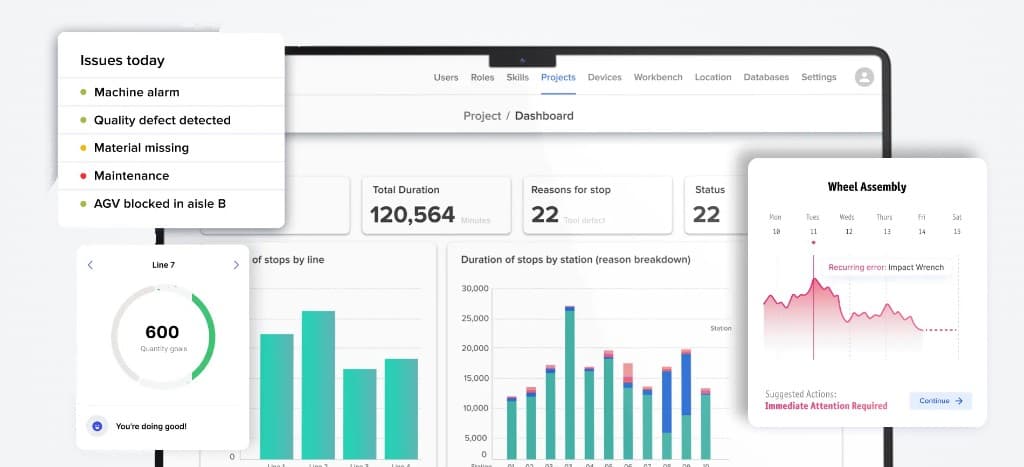
What runs is measured. Where the process loses time, quality or material becomes visible, and that becomes the next improvement.
Today we run this loop together with your team, on the data the applications produce.
Governance
What we touch, and what we do not.
Shopfloor teams need applications that fit the work. IT needs a stack that stays under control. Workerbase is built for both.
- We read from ERP, MES, quality and machine data. Machine control and planning stay where they are.
- Every application carries roles, approvals and a log by default. You can see what runs where, who built it and which version is live.
- Identity, rights and operations follow your standards
- Data protection and the EU AI Act are handled at the point of release, by a named human
- Deploy workflows on the devices you already own: Smartphone, Tablet, PC or Smartwatch.