Speed
Traditional MES / consulting
Slow
6-12 month projects per workflow
Generic AI / vibe coding
Fast
Days or weeks, but requires developers
Workerbase AI
Minutes
Ops team builds it, within the rules IT sets.
Close your shopfloor execution gaps
Every worker connected to the knowledge they need. Every process deployed in days. Every action tracked from trigger to close.
Trusted by manufacturing leaders at







Build
Describe a process in plain language. The App editor and modular components turn it into a running shopfloor app. No six-month project.
Govern
Every app approved before it runs, versioned, reversible, and fully audited. Compliant by architecture.
Empower
Workers get answers and AI-guided troubleshooting at the station. Operations teams build without waiting on IT. Supervisors see everything, chase nothing.
How it works
One platform, four building blocks that work together, from the App editor and worker UI down to the automations that run the process.
App editor
Assemble apps from tested modules and guide workers at the station on tablets, phones, and wearables.
Integrations into your existing systems
100+ prebuilt connectors to ERP, MES, SCADA, and sensors for real-time context. No middleware project.
Workerbase databases for shopfloor data
Structured, versioned data managed inside the platform and queryable from every workflow.
Automations for processes and business logic
Encode triggers, escalations, and write-backs once. Every workflow runs the logic consistently.
01
App editor
Guide workers at the station
02
Integrations
100+ systems, real-time context
03
Data layer
Shopfloor data managed for you
04
Automations
Business logic in every workflow
AI for everyone on your shopfloor
One platform that Builds fast, Governs by design, and Empowers every role, from the station to the plant office.
Frontline workers
Guided instructions at the station, plus AI agents on hand to troubleshoot in seconds.
Supervisors
Auto-generated shift summaries and escalations routed to the right person, so issues surface before they become problems.
Operations teams
Ship improvements as fast as you can describe them. Compounding gains on every process you digitize.
What gets solved on the shopfloor
Each use case runs inside the same enterprise-grade execution engine – proven across 40+ plants in automotive, heavy industrial, and logistics.
Phase 1: AI Assists
Workers ask in plain language and get answers pulled from manuals, SOPs, and machine history, without interrupting an expert.
Live at the station
Questions workers ask on shift, answered in context.
LINE 3 · MACHINE C3-A · SHIFT A
Alarm 002 active
WORKERBASE AI · KNOWLEDGE
Sensor fault: conveyor unit C3-A
Source: Maintenance Guide v4.2 · Last resolved March 14 by J. Schmidt
SHIFT INSIGHT · REWORK · LAST 3 DAYS
47 rework events · Line 2 accounts for 60% · All three shifts affected
Natural language Q&A across your full factory knowledge base. No prompt engineering needed. Workers ask in plain language. Answers come with direct links to source documents.
Troubleshooting support, shift handover summaries, rework guidance, product history. Connected to shift reports, SOPs, manuals, maintenance logs, checklists.
Structured capture of machine interruptions, rework events, quality feedback. Voice or text input: AI structures the data automatically, consistently, every time.
Auto-generated, structured, ready in seconds. Multi-language support built in.
Phase 2: AI Creates
Build turns a plain-language prompt into a running shopfloor app. Four building blocks handle everything from the worker UI to the business logic behind the scenes.
Preview in Agent Builder
Describe once. The engine proposes structured steps you can review and deploy.
Operations manager describes:
Trigger: Machine alarm detected on Line 4
Notify: Certified technician (skill-matched, on-shift)
Attach: 3 recent maintenance logs + fault code checklist
Escalate: If unacknowledged after 10 min → supervisor alert
Close: Verify completion + write back to CMMS
Describe the workflow. The editor assembles an app from tested modules, ready for the station on tablets, phones, and wearables.
100+ prebuilt connectors to ERP, MES, SCADA, and sensors. Real-time context, no middleware project.
Shopfloor data managed inside Workerbase: structured, versioned, and queryable from every workflow.
Business logic encoded once and applied to every workflow. Triggers, escalations, and write-backs handled automatically.
Phase 3: AI agents improve continuously
Every workflow run creates structured execution data. AI agents analyze it continuously, surface patterns, and propose ready-to-deploy improvements, not another dashboard.
Execution intelligence
Week-over-week analysis becomes a deployable workflow, not another dashboard.
AI Insights: Week 14 analysis
Bottleneck detected: Line 7 handover
Avg. 23-min delay at shift handover on Line 7. Occurs 4x per week. Root cause: incomplete inspection logs at close of shift.
Escalation pattern: Fault code E-44
67% of E-44 escalations resolved by the same fix. Current workflow skips it. 3 unnecessary supervisor callouts per week.
Update Line 7 shift-close checklist
Add mandatory inspection sign-off before handover. Estimated time saving: 20 min/shift.
AI identifies recurring bottlenecks, escalation hotspots, and process gaps across thousands of workflow runs. Surfaced before they become production problems.
Improvement proposals come as editable workflows, not reports. Review, adjust, and deploy in minutes. The execution engine handles rollout.
Every new workflow adds to the dataset. The more Workerbase runs, the more precisely AI can identify what slows your lines down and what fixes it.
Improvements deploy into the same execution engine. Results feed back into the next analysis cycle. Continuous improvement becomes a system property, not a project.
What changes
Finding information
Training new staff
Shift handover
Knowledge retention
Creating workflows
Reacting to problems
The impact on your daily operations
Built with frontline operators in mind. Workers solve problems independently, without waiting for experts or hunting through documentation.
Workerbase already knows the task, machine, and status before displaying anything. Only need-to-know information is shown. No generic answers.
Captures how experienced workers actually solve problems: which steps they skip, adjustments they make, workarounds they use when standard procedures don't apply.
Lives inside work instructions, dashboard alerts, and maintenance tasks. Workers never leave their screen or switch to a separate app.
Connects to your ERP, MES, SCADA, and machine controllers through prebuilt connectors. No middleware, no data lakes, no six-month IT projects.
Why it's different
Most AI tools were built for offices. Here's what that means when you try to use them on a production floor.
Traditional MES / consulting
6-12 month projects per workflow
Generic AI / vibe coding
Days or weeks, but requires developers
Workerbase AI
Ops team builds it, within the rules IT sets.
Traditional MES / consulting
Rigid but governed
Generic AI / vibe coding
Non-deterministic, no audit trail, no governance
Workerbase AI
Deterministic output, role-based guardrails, human-in-the-loop
Traditional MES / consulting
Controlled but slow
Generic AI / vibe coding
Workerbase AI
Connect your AI agents
Connect your AI agents, LLMs, and enterprise tools directly to Workerbase's execution layer. The MCP server exposes live shopfloor data (tasks, assets, workflows, shift status) to any AI model in real time.
AI Agent asks
workerbase.getShiftStatus({
  plant: "line_4",
  date: "today"
})
Workerbase responds
Line 4 · Shift A · 6 open tasks. 2 overdue escalations. OEE: 84%. Last alarm: conveyor fault at 09:14, resolved in 11 min. Shift handover scheduled in 47 min.
AI Agent asks
workerbase.triggerWorkflow({
  template: "alarm_response",
  asset: "conveyor_C3"
})“The Workerbase platform ensures that our processes run smoothly, issues are resolved quickly and production operates with fewer interruptions.”Read the full story
Jens Bruecker
Vice President Plant Zuffenhausen, Porsche
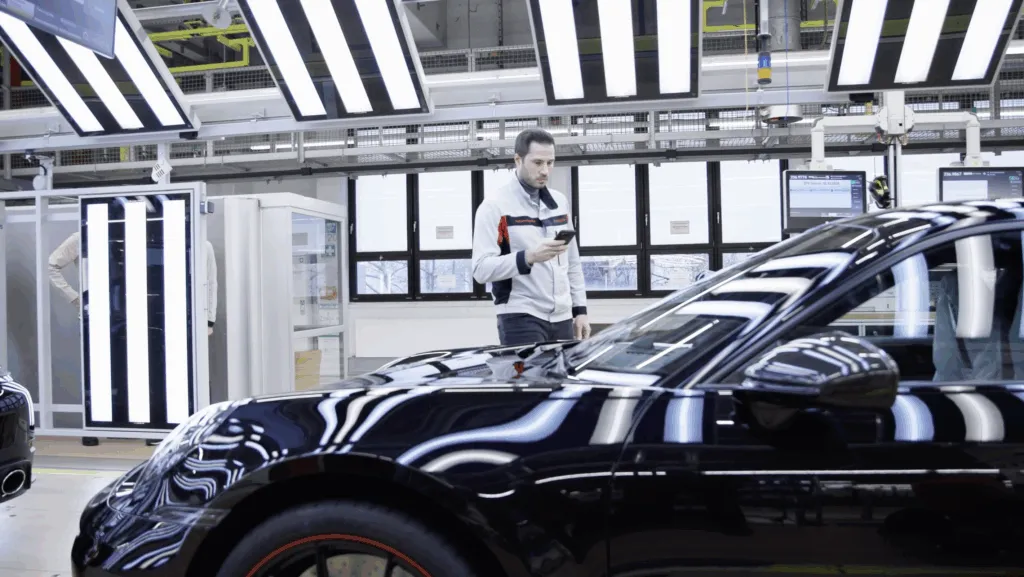
12-15% productivity improvement across 10+ use cases per factory
Shopfloor digitalization at scale, from assembly to quality to maintenance.
35% reduction in production downtime. 3,500 additional bikes per year.
One process automated. Immediate, measurable impact on output.
80% of manual shopfloor processes automated
From paper-based operations to fully orchestrated execution in months.