How to Share Best Practice Across Shifts
Share article
Quick answer: A fix that disappears the moment that operator changes shifts, calls in sick, or leaves the company is a systematic issue within manufacturing organizations. As workers retire or churn, capturing best practices gained from years of experience on the job is absolutely critical. Leading manufacturers are now looking to capture worker experience and best practices as digital work instructions bound to the machine or station, in photo, video, or voice, at the moment it happens, and it survives past the person who found it and reaches every shift that runs that line.
Manufacturers trying to share best practice manufacturing knowledge across shifts keep hitting the same wall: the person who found the fix is the only place the fix lives. A gasket that seals better half a turn looser. A torque sequence that stops a rattle nobody else can reproduce. A sensor that needs a five-second pause before the next step, or it throws a fault that isn't actually a fault. None of it gets written down, because writing it down was never anyone's job, and by the time someone tries to pass it on at a handover meeting, the records often don't actually convey the fix actually was.
Digital work instructions close that gap by binding knowledge to the machine, station, or order it belongs to, and by capturing it the moment it happens instead of asking someone to reconstruct it from memory later. On a station-based assembly line, that means the fix a night-shift operator found at 3 a.m. is the same fix the day shift sees at the same station, the same day.
Why does a fix from the one shift never reach the next?
A fix stays with one shift because nothing exists between the moment an operator solves a problem and the next person who needs the same fix. The knowledge sits in one person's head, gets mentioned once in a handover conversation if there's time, and is gone the day that operator is on leave, moved to a different line, or retires.
Shift handover itself is a fragile moment even when nothing new needs to be passed on. HSE's guidance on safety-critical communications names poor shift handover as a contributing factor in some of the most closely investigated industrial accidents on record, because a handover happens once, under time pressure, and whatever isn't said clearly doesn't get a second chance before the next shift is already running the line. A production fix competes with everything else that has to get said in that same short window: what's short on the line, what quality flagged, who's out. It's the first thing that gets dropped.
The result is a fix that exists exactly once, in one person's head, until it's needed again on a shift where nobody remembers it. It's the same failure mode behind why manufacturers keep losing knowledge generally: the knowledge was never missing, it just never had anywhere to live outside one person.
How do you capture a fix in photo, video, or voice instead of a written report?
An operator describes what they did in whatever form is fastest, a photo of the adjustment, a short video of the sequence, or a spoken note, and that becomes the structured instruction the next shift sees at the same station, rather than a paragraph typed up after the fact.
A worker who says "filter heavily contaminated, cleaned it, no visible damage" doesn't need to also fill in a form. Workerbase's AI knowledge capture turns a spoken or typed note or a short video into structured fields, condition, action, damage, status, so the record exists without the operator doing double work. The same applies to standard operating procedures built from an existing SOP, a photo of a setup, or a short recording of the sequence: the content a plant already has becomes the instruction the next shift follows, rather than a new authoring project nobody has time for.
None of this runs unsupervised. Every captured instruction is reviewed and approved before it reaches a station, every version is tracked, and a bad edit is reversible in the time it takes to roll it back. That's what makes it safe to let a night-shift fix go live on the floor by the next shift instead of waiting for the next scheduled SOP review. The same AI capture that turns a spoken fix into a structured step can also generate a shift-handover summary from what actually happened during the shift, rather than what the outgoing supervisor remembers to say out loud.
How do you turn a one-off fix into a standard every shift actually follows?
A fix becomes a standard when the next step won't open until the current one is confirmed, so following it isn't optional and skipping it isn't silent. Digital shift handover carries the same logic forward between shifts: open issues, recent fixes, and what changed are passed on as structured entries the incoming shift has to acknowledge, not as whatever the outgoing supervisor remembers to mention on their way out.
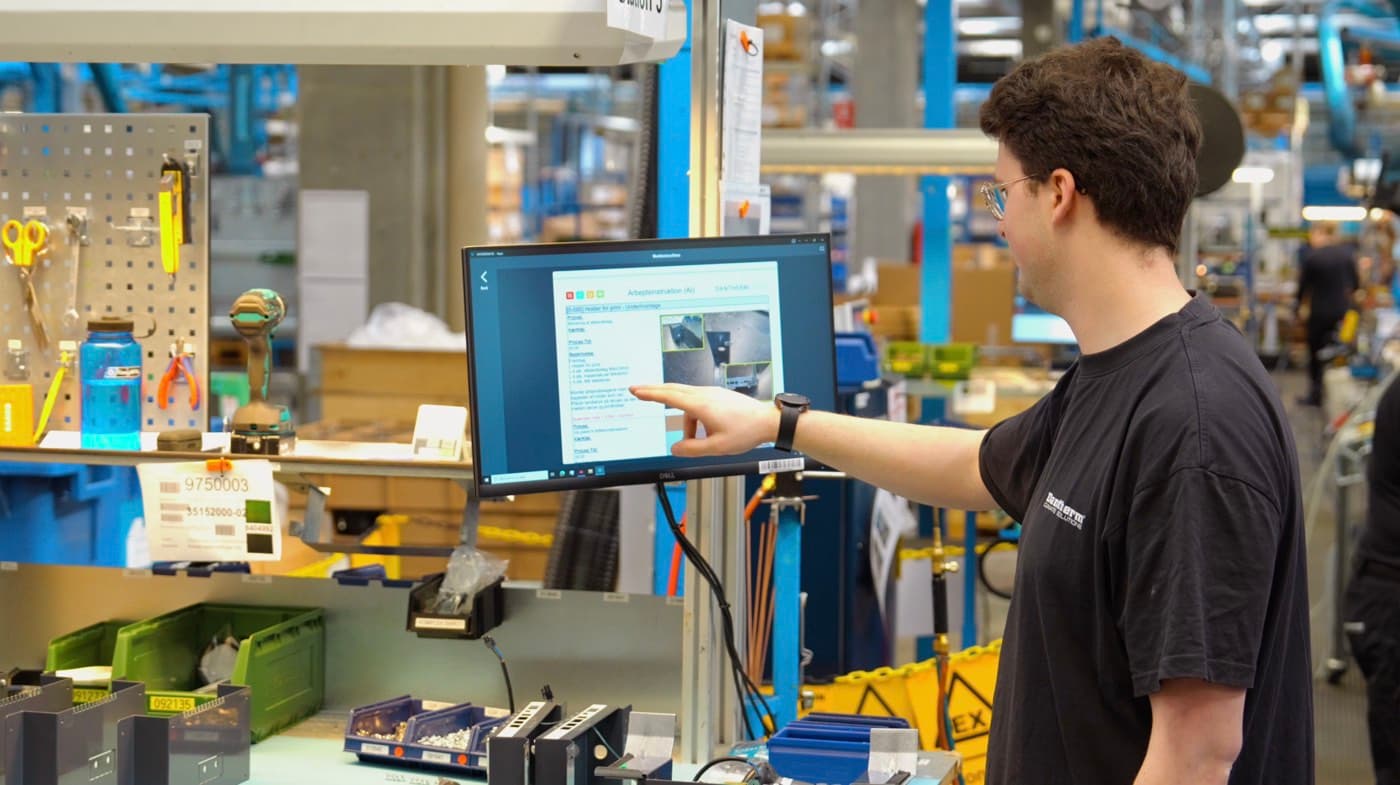
Dantherm applied this to its production floor and eliminated paper processes across the line, cutting unplanned production stops due to quality issues by 36%, with full traceability from the workstation back to ERP. That traceability comes from capturing the record at the station, at the moment the work happens, rather than from anyone getting better at writing things down afterward.
What does it actually cost to keep losing this knowledge?
It costs more every year the workforce that holds the knowledge gets older. Deloitte and The Manufacturing Institute's skills-gap study puts the number at up to 1.9 million unfilled US manufacturing jobs by 2033, with the retirement of experienced workers cited by employers as one of the three largest drivers. Every one of those retirements takes a set of fixes nobody ever wrote down out the door with it, permanently.
The same pattern shows up before anyone even retires. LNS Research's work on industrial knowledge management finds that 72% of industrial organizations already say frontline hiring, onboarding, and retention problems are hurting operational performance, and every shift in between someone's departure adds its own cost: a fix that worked once has to get rediscovered from scratch because nobody could find where it was recorded.
"Workerbase makes the whole shopfloor more dynamic, more agile," says Paul Mairl, CDO of GKN Powder Metallurgy. "We are much quicker in reacting to the ups and downs every production has." That speed comes from the same source as the knowledge-transfer problem: whether what one shift learns is available to the next one, or has to be relearned.
Common mistakes when trying to share best practice across shifts
Treating handover as a meeting instead of a system. A five-minute conversation at shift change can carry maybe three things reliably. A fix that matters gets said once and is gone if the listener doesn't retain it.
Writing the fix down after the fact. By the time someone types up what happened at the end of a shift, the specific detail that made the fix work, the exact half-turn, the exact pause, is usually the first thing that gets lost.
Building a library nobody can search by machine or fault code. A folder of past fixes that isn't attached to the asset or the fault it solves is no more useful than the SOP binder it replaced. The fix has to surface at the station when the same fault comes up again, not require someone to remember it exists.
Frequently Asked Questions
What's the difference between a digital shift handover and a digital work instruction?
A shift handover passes open issues and recent events from one shift to the next as a structured record the incoming shift has to acknowledge. A digital work instruction is the standing instruction at a station or machine. A fix captured during handover becomes part of the work instruction once it's confirmed as the new standard, so the two connect rather than compete.
Can an operator log a fix by voice instead of typing a report?
Yes. A spoken description of what was done gets turned into structured fields, condition, action, or whichever fields the plant defines, so the operator doesn't lose time typing up something they already fixed with their hands.
How long does it take to get existing fixes and tribal knowledge into a searchable system?
Existing SOPs, setup sheets, and prior fixes can be brought in as they are rather than rewritten first. A plant can be live with the current content on one line in about two weeks, with 85% of the configuration handled by the ops team rather than IT.
Does this replace our shift handover meeting?
No. It gives the meeting something concrete to point at instead of relying on memory. Open issues and recent fixes are already logged before the conversation happens, so the handover becomes a confirmation rather than the only record that ever existed.
Once a fix is captured, does it automatically become the new standard?
No. Every captured fix is reviewed and approved before it replaces or updates a live instruction. Nothing reaches a station unapproved, and any change can be rolled back instantly if it turns out to be wrong.
Is this only worth it for large plants running many shifts?
The problem scales with the number of handoffs, not the size of the plant. A two-shift line with one experienced operator has exactly the same exposure as a five-shift plant: one person's knowledge, one handover, one point of failure.